Thailand entry requirements checklist 2026
 By Cesar RodriguezUpdated
Answer six questions and get the list that applies to your passport, your dates and what is in your bag — each item with the rule behind it, the source it comes from and the date we last checked it.
Arrival paperwork is the most-repeated subject in our r/Thailand and r/Bangkok archive: 24 to 34 threads and 788 to 939 comments a month through August 2026. The cut from 60 to 30 visa-free days drew 14 threads and 192 comments in the first week of September 2026 alone, and the vape ban turns up 117 times across 104 threads, usually attached to a fine figure someone half-remembers. This page exists because those figures move and most of the answers online are undated.
Changed 15 September 2026: Land-border visa-exempt entries capped at two a year
Visa-exempt travellers who cross by land, border-run long-stayers. What changed, and what to do about it
The permitted stay changes on 15 September 2026, so the date decides the answer.
6 of 17 items are required for this trip. Rules last checked 7 September 2026.
1. Passport valid 6 months beyond arrival, 1 blank page
RequiredThe UK Foreign Office states the rule plainly: your passport needs an expiry date at least 6 months after the day you arrive, plus at least one blank page. The recurring argument online is whether 6 months is a hard rule or a guideline — the practical answer is that it stops mattering at the immigration counter, because airlines check the same figure through Timatic at check-in and refuse boarding below it. Renew if you are inside 6 months, even for a two-week trip.
Source: UK FCDO — Thailand entry requirements — verified 7 September 2026
2. Know which entry permission you get, and for how many days
RequiredPick your nationality above and this line fills in with the exact stay length you get on your chosen arrival date — the number changes on 15 September 2026 for most passports.
Source: Best of Thailand — visa checker — verified 24 September 2026
3. Thailand Digital Arrival Card (TDAC), free, within 72 hours
RequiredMandatory for every foreign national arriving by air, land or sea since 1 May 2025 — it replaced the paper TM6 card. Submit it at tdac.immigration.go.th up to 3 days (72 hours) before you land, including on the day itself. It is free: any site charging a processing fee is not the government one. One submission covers one entry, so a trip with a side flight to Vietnam and back needs two. If you land without it, Suvarnabhumi, Don Mueang, Phuket, Chiang Mai and Hat Yai have self-service kiosks before immigration.
Source: Thailand Digital Arrival Card — official portal — verified 7 September 2026
4. Proof of onward or return travel
RequiredA confirmed ticket out of Thailand dated inside your permitted stay is a written condition of visa-exempt entry: the Royal Thai Embassy's conditions accept air, train, bus or boat tickets and ask for them at the port of entry. Most travellers meet the check at airline check-in, because the airline has to fly a refused passenger back out, but immigration officers ask too, mostly of repeat visitors. A one-way ticket plus a plan is not enough for most carriers.
Source: Royal Thai Embassy, Wellington — visa exemption conditions — verified 17 October 2026
5. Proof of funds: ฿10,000 per person, ฿20,000 per family
RequiredThe Tourism Authority of Thailand restated the figures on 6 July 2026: ฿10,000 per person or ฿20,000 per family for visa-exempt, transit and visa-on-arrival entries; ฿20,000 per person or ฿40,000 per family on a tourist visa. Thai baht, an equivalent amount in another currency, or documents evidencing the equivalent all count, and children under 12 are exempt. The rule dates from 1980 and was updated in 2000 — it is not new, it is enforced at officers' discretion, and most arrivals are never asked. Being one of the few who is asked, with nothing to show, is a refusal of entry.
Source: TAT Newsroom — proof-of-funds reminder, 6 July 2026 — verified 7 September 2026
6. An address in Thailand for the arrival card
RequiredThe TDAC form will not submit without an address in Thailand, which catches out people who planned to find a room on arrival. Your first confirmed night is enough — the form is a registration, not a commitment, and changing hotels afterwards needs no update. Filing the TM30 notification for wherever you sleep is the property's job, not yours (see below).
Source: ThaiEmbassy.com — TDAC step-by-step guide — verified 7 September 2026
7. Land-border entries on the visa exemption are capped
Not for your tripYou said you are flying in, so the land-border cap does not bite. It is worth knowing if a border run to Laos or Cambodia is anywhere in your plan: the limit is counted per calendar year, not per trip.
Source: TAT Newsroom — new 30-day and 15-day visa exemption rules from 15 September 2026 — verified 16 October 2026
8. 30-day extension at an immigration office (฿1,900)
Worth doingA visa-exempt or tourist-visa stay can be extended once, by 30 days, for ฿1,900 at the immigration office for the address on your TM30 (in Bangkok, Chaeng Watthana). Pick your nationality above to see whether your planned stay needs one.
Source: Best of Thailand — visa checker — verified 7 September 2026
9. TM30 — your host files it, not you
Worth doingUnder section 38 of the Immigration Act the owner or manager of the place you sleep must notify Immigration within 24 hours of your arrival. Hotels file it automatically and you will never hear about it. Condo and private rentals are where it goes missing, and a missing TM30 surfaces later — at a visa extension or a 90-day report — as your problem to fix. If you are renting privately, ask the host once, in writing, whether they have filed it.
Source: ThaiEmbassy.com — TM30 notification of residence — verified 7 September 2026
10. 90-day report (TM47) if you stay past 90 days
Not for your tripA 14-day stay never reaches the 90-day reporting line, so there is nothing to file. It starts counting from your arrival, not from a visa's issue date, if you extend later.
Source: Siam Legal — 90-day reporting — verified 7 September 2026
11. Overstay: ฿500 a day, capped at ฿20,000
Worth doingWorth knowing before you plan a tight departure, not after. The Royal Thai Embassy's own advisory puts it at ฿500 per day, reaching the ฿20,000 ceiling at 40 days, paid when you exit. Past 90 days it stops being a fine and becomes a re-entry ban — reported as 1 year for over 90 days, 3 years for over a year, 5 years for over 3 years, 10 years for over 5 years, with a longer minimum ban if you are caught rather than leaving voluntarily. We could not load an Immigration Bureau page carrying that ladder in English, so the fine is verified and the ban lengths are as published by embassies.
Source: Royal Thai Embassy, Bucharest — overstaying in Thailand — verified 7 September 2026
12. Prescription medication
Not for your tripNothing to arrange if you are not carrying prescription drugs. If that changes before you fly, check the medication guide first — the categories that need a permit are not the ones most people expect.
Source: Best of Thailand — bringing medication into Thailand — verified 7 September 2026
13. Yellow fever certificate if you arrive from or through Africa or South America
Worth doingOnly if your trip starts in, or passes through, one of the 45 countries on Thailand's yellow fever list: 32 in Africa (Kenya, Ethiopia, Nigeria and Ghana among them) and 13 in the Americas (Brazil, Colombia, Peru and Argentina among them). Your passport does not decide it; your route does. The Ministry of Public Health asks for the International Certificate of Vaccination at the port of entry. The UK's travel health service puts the rule at travellers aged 9 months or over, and counts an airport transit of more than 12 hours in a listed country, such as a long layover in Addis Ababa or Nairobi. A certificate is valid for life. The list we checked was last updated in November 2022, so check it again before you book a route through Africa or South America.
Source: Thailand MFA — countries that require a yellow fever certificate (page updated 30 November 2022) — verified 27 September 2026
14. Vapes and e-cigarettes: leave them at home
Worth doingYou said you are not bringing one, which is the right answer. Note it also covers buying or borrowing one here: possession is the offence, not just importing, and the ban has held since 2014 with no personal-use exemption.
Source: UK FCDO — Thailand safety and security — verified 7 September 2026
15. Drone: register with NBTC and CAAT
Not for your tripNothing to do without a drone. If one joins the packing list later, start with the registration rules — Bangkok is almost entirely inside airport no-fly zones anyway.
Source: UK FCDO — Thailand safety and security — verified 7 September 2026
16. Declaring cash at customs
Not for your tripNothing to declare below the threshold. If your plans change, the declaration is free and takes a minute in the red channel; the penalty for not making it is seizure.
Source: Thai Customs Department — travellers — verified 7 September 2026
17. Travel insurance is not required — and still worth having
Worth doingNot a condition of entry as of September 2026: the UK FCDO's Thailand entry-requirements page lists passport validity and the arrival card, not insurance, and no Thai entry rule requires it. Proposals to make cover compulsory for all visitors have surfaced repeatedly without a confirmed start date, so anyone telling you it is already mandatory is ahead of the rules. Bangkok private-hospital bills are the reason to carry it anyway.
Source: UK FCDO — Thailand entry requirements — verified 7 September 2026
What changed, and when
Every entry rule on this page that moved in 2025 or 2026, newest first, with the date it takes effect rather than the date it was announced — those are often weeks apart in Thailand, because Interior Ministry notices commence fifteen days after Royal Gazette publication.
Land-border visa-exempt entries capped at two a year
The 30-day visa exemption can be used at a land checkpoint no more than twice per calendar year. Nationals of Malaysia, Brunei, Indonesia and Singapore are exempt, plus any nationality the Interior Minister designates later. Entries by air and sea are not counted. Our checklist treated Laos and Vietnam as exempt until 16 October 2026; TAT's notice does not name them, so they now see the cap.
Affects: Visa-exempt travellers who cross by land, border-run long-stayers — source: TAT Newsroom — new 30-day and 15-day visa exemption rules from 15 September 2026
Visa-exempt stays cut from 60 days to 30
The 60-day unilateral visa exemption for 93 nationalities became 30 days for 60 countries and territories, with a 15-day tier for Mauritius and Seychelles and visa on arrival for Azerbaijan, Belarus and Serbia only. India and Maldives, reported in August as moving to visa on arrival and 15 days, are on the 30-day list; Andorra, Monaco, San Marino and Vatican City are on none (corrected here on 24 September 2026). The one-time 30-day extension (฿1,900) survives, so a visa-free trip now tops out at 60 days rather than 90. Bilateral treaties (South Korea, China, Brazil and the rest) are separate instruments and are untouched. Effective 15 September 2026, from the Interior Ministry notices published in the Royal Gazette on 31 August 2026.
Affects: Every visa-exempt and visa-on-arrival nationality — source: TAT Newsroom, 1 September 2026
DTV applications restricted to your own country
Destination Thailand Visa applicants must now apply at a Thai embassy or consulate in a country where they hold citizenship or permanent residence — the Vientiane, Phnom Penh and Kuala Lumpur route is closed — and must submit a recent criminal record certificate. Applications with the fee fully paid before this date are assessed under the previous rules.
Affects: DTV applicants, especially remote workers already in Asia — source: ThaiEmbassy.com — end of the 60-day visa-free stay
Proof-of-funds rule restated for arrivals
Not a new rule but a public reminder that officers can ask: ฿10,000 per person or ฿20,000 per family on a visa exemption, transit or visa on arrival; ฿20,000 per person or ฿40,000 per family on a tourist or non-immigrant visa. Cash, foreign currency or documents evidencing the equivalent all count, and under-12s are exempt. The requirement dates from 1980 and was last updated in 2000.
Affects: All arrivals, at the officer's discretion — source: TAT Newsroom — proof-of-funds reminder, 6 July 2026
Repeat visa-exempt entries refused
The Immigration Bureau began turning away travellers making repeated visa-exempt entries in a calendar year without a reason it accepts, at airports and land checkpoints alike, and stopped granting extensions to travellers who entered by land. The practical effect is that back-to-back border runs stopped working as a long-stay strategy.
Affects: Frequent visa-exempt entrants and border-run long-stayers — source: KPMG Flash Alert 2025-255 — repeat visa-exempt entries
Thailand Digital Arrival Card replaces the TM6 card
A free online arrival card became mandatory for every foreign national entering by air, land or sea, replacing the paper TM6 form. Submitted at tdac.immigration.go.th up to 72 hours before arrival, valid for one entry, with kiosks at the five main airports for anyone who lands without it.
Affects: Every foreign traveller — source: Thailand Digital Arrival Card — official portal
The same list is available as an RSS feed.
The official videos
Both published by the agency that applies the rule, not by a travel channel. Nothing loads from YouTube until you press play.
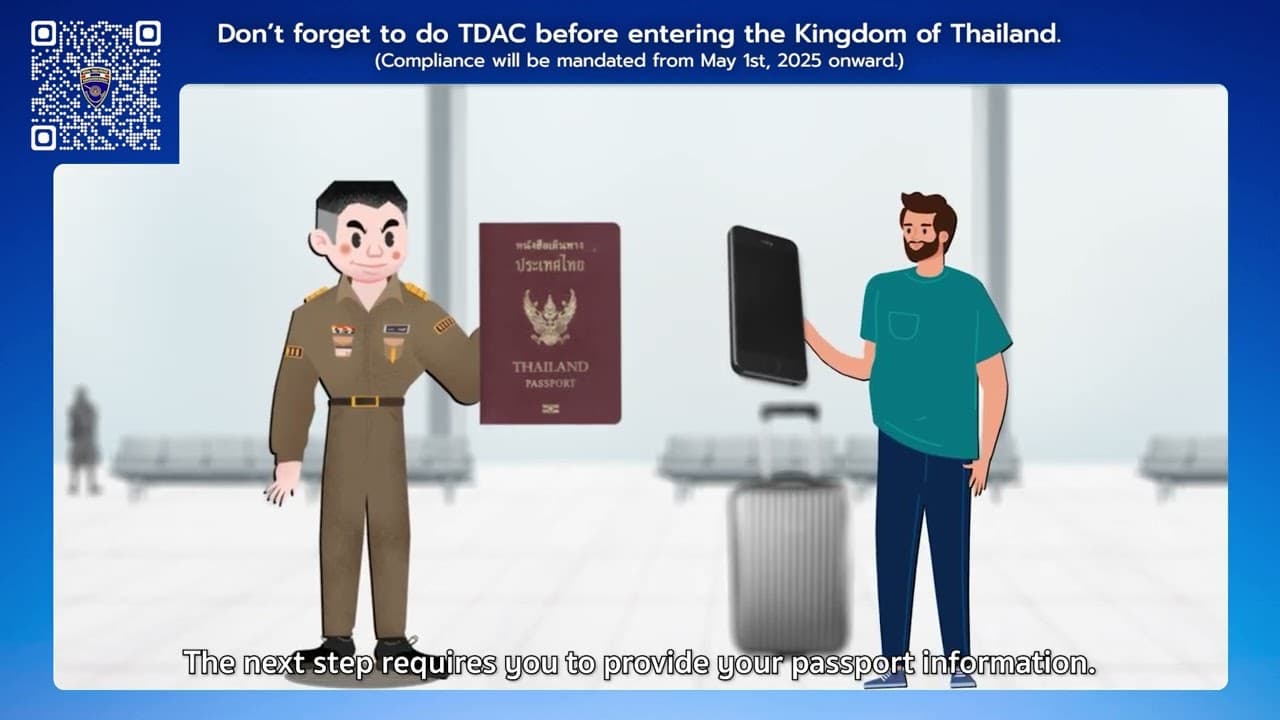 Play: Thailand Digital Arrival Card (TDAC)
The Bureau's 2:44 walkthrough of the form at tdac.immigration.go.th: passport by photo upload or typed in, flight and accommodation, the health declaration the system asks for from some nationalities and recent travel histories, adding companions, and the confirmation you download or receive by email to show at the desk. Thai nationals are exempt; the 3-day window is stated on screen.
Thai Immigration Bureau (the Immigration Bureau of the Royal Thai Police) on YouTube, 1 April 2025, 2:44. Checked 22 September 2026.
 Play: GET READY FOR THAILAND
Five checks from the Bureau: 6 months of passport validity and no damaged pages, the visa type and its day count, the arrival card, the Non-Immigrant B and work permit if you plan to work, and the extension, 90-day report and re-entry permit rules for longer stays. Filmed July 2025: the 60 visa-free days it quotes for exempt nationalities became 30 on 15 September 2026, which the checklist above reflects.
Thai Immigration Bureau (the Immigration Bureau of the Royal Thai Police) on YouTube, 8 July 2025, 4:08. Checked 22 September 2026.
Email me when Thailand's entry rules change
One message per change, sent when a rule on this page moves — nothing else. Five changes have qualified since May 2025, so expect a handful a year rather than a newsletter.
Frequently asked questions
Do I still need the arrival card if I already have a Thai visa?
Yes. The Thailand Digital Arrival Card is a registration, not a permission — it applies to every foreign national regardless of visa, including DTV and long-stay holders, and to arrivals by land and sea as well as air. It is free at tdac.immigration.go.th, can be submitted up to 72 hours before you land, and covers one entry only, so a side trip to Vietnam and back needs a second one. Suvarnabhumi, Don Mueang, Phuket, Chiang Mai and Hat Yai have kiosks before immigration for anyone who arrives without it.
How long can I stay in Thailand visa-free after 15 September 2026?
30 days for the 60 countries and territories on the published list (India and Maldives included), 15 days for Mauritius and Seychelles, and a 15-day visa on arrival for Azerbaijan, Belarus and Serbia. The one-time 30-day extension at an immigration office survives at ฿1,900, so the ceiling for a visa-free trip goes from 90 days to 60. Bilateral treaty countries — South Korea at 90 days, China at 30 and the rest — are unaffected, because those are separate instruments.
Does Thailand really check proof of funds at the border?
Rarely, and at the officer's discretion, but the power is real and was restated publicly on 6 July 2026: ฿10,000 per person or ฿20,000 per family for visa-exempt, transit and visa-on-arrival entries, ฿20,000 and ฿40,000 on a tourist visa. The DTV is a non-immigrant visa, so the ฿20,000 per person figure applies to it too. Children under 12 are exempt. It does not have to be cash — foreign currency or documents evidencing the equivalent count, so a bank app balance or a printed statement satisfies it. The requirement dates from 1980, which is why nobody remembers it until they are asked.
Can I be refused boarding or entry without an onward ticket?
Yes, at either end. The Royal Thai Embassy's conditions for visa-exempt entry ask for a confirmed air, train, bus or boat ticket leaving Thailand within your permitted stay, so a bus ticket to Laos or Cambodia counts as much as a flight. Check-in is where most people meet the rule: international aviation rules make the airline remove a passenger the destination refuses, so agents check the ticket before you board. At the immigration desk it is discretionary and lands mostly on repeat visitors; the UK Foreign Office's page, updated 12 October 2026, says officers may ask frequent tourist entrants for onward travel, accommodation and funds. On r/ThailandTourism, a British traveller on their third visa-exempt entry of 2026 was refused at Phuket on 23 July for the missing ticket alone; the thread drew 233 comments, and up to 56 threads asked about onward tickets between mid-July and mid-October across r/Thailand, r/Bangkok and r/ThailandTourism. Keep the booking, in your name and dated inside your 30 days, on your phone.
What actually happens if you bring a vape into Thailand?
The UK Foreign Office describes confiscation, fines it puts at typically ฿5,000–30,000, detention and court proceedings, with no exception for tourists or personal use — and adds the part travellers underestimate: you may be required to remain in Thailand until the case is finalised. Possession is the offence, not just importing, so buying one after you land is not a way round it. Individual tourists have reported larger one-off fines, including ฿40,000 in 2026; single cases are not a published schedule.
Is travel insurance required to enter Thailand?
No. As of September 2026 no Thai entry rule requires it, and the UK Foreign Office's Thailand entry page lists passport validity and the arrival card but not insurance. Proposals to make cover compulsory for all visitors have surfaced repeatedly without a confirmed start date. The reason to buy it is the bill at a Bangkok private hospital, not the immigration counter.
Can I bring a drone for a two-week trip?
Usually not, on timing alone. Any drone with a camera needs registration with both the NBTC and CAAT — a sub-250g Mini included — and since January 2025 neither can be started from abroad, because both need a Thai phone number and your arrival stamp. CAAT registration is reported to take up to 14 days and includes a written test; third-party liability cover of ฿1,000,000 is also part of it. The UK Foreign Office puts the penalty for missing NBTC registration at ฿100,000 or five years, or both.
What we could not verify
Five figures on this subject are repeated everywhere and traceable nowhere we could open. They are listed here rather than printed above as though they were settled.
- Whether the two-entry land cap applies to Lao and Vietnamese passports, which enter under bilateral agreements rather than the 60-country exemption. TAT's notice names only Malaysia, Brunei, Indonesia and Singapore as exempt; the Laotian Times (18 September 2026) reads Lao citizens as outside the cap, citing unnamed diplomatic channels. We could not load the Royal Gazette notice, so the checklist applies the cap to both.
- The customs declaration threshold for cash. USD 15,000 is the figure repeated across travel sites and USD 20,000 appears on older Thai government pages; we could not load a current Customs Department page stating either, so the checklist tells you to read the form at the checkpoint instead of quoting a number.
- The 90-day report's late-filing fines (฿2,000 voluntary, ฿5,000 if caught). Both come from a Thai law firm's summary, not from an Immigration Bureau page we could open.
- The overstay re-entry ban ladder (1, 3, 5 and 10 years). Thai embassies publish it; the ฿500-a-day fine and ฿20,000 cap are confirmed on the Royal Thai Embassy advisory, the ban lengths are not on a page we could load.
- How strictly the two-entries-a-year land-border cap is applied. Enforcement was restated in November 2025 and reporting has been inconsistent since, so we present two as a planning ceiling rather than a published allowance.
- The yellow fever age limit (9 months) and the 12-hour transit rule. They come from the UK's NaTHNaC page on Thailand quoting the International Health Regulations; the Thai MFA list names the countries but not the age or the transit threshold, and it was last updated in November 2022.
- Whether mandatory travel insurance for visitors is going ahead. The proposal keeps resurfacing with no confirmed start date, and no Thai entry rule requires cover today.
How this page is sourced
Last verified 7 September 2026. Each checklist item above carries its own source link and its own verification date, because they do not move together — the visa-exemption figures changed twice in 2026 while the proof-of-funds amounts have stood since 2000. Where a government page states a figure, that is what we quote; where only a law firm or a travel publisher does, the item says so in its own text. Nothing here is legal advice, and the binding versions are the Royal Gazette notices and the Immigration Bureau.
For stay lengths by nationality, the visa checker has the full country lists. For what you can and cannot carry in a medicine bag, see bringing medication into Thailand. Landing at Suvarnabhumi or Don Mueang and working out the ride into town: airport to city.
Two items on the list are worth settling before you fly. The arrival card is a government web form, not an app — but the SIM you will file it on, and the ride-hailing and translation apps worth having on the phone when you land, are in eSIM & apps. And if you plan to carry the ฿10,000 in cash, the airport exchange counters run 5–10% below the city booths: change enough for the taxi and do the rest in town, as the baht & money guide sets out.
Canonical URL for this checklist: https://bestofthailand.org/entry-checklist
Related guides
All guides and tools
Staying
Moving around
Eating & going out
Rules & safety
Best of Thailand
https://bestofthailand.org/entry-checklist
Scan or type the address for opening hours, phone numbers and the map.